


Haptic Reactors for Sim Racing: The Complete Guide

When we talk about haptic reactors, there are several modalities within this section: from bass shakers to pedal accessories, including feedback cushions and other intermediate solutions. These are small accessories that are incorporated into a setup or cockpit to improve immersion without needing to invest in a complete motion system.
Quick summary:
- Haptic reactors add physical feedback without moving the cockpit, unlike a motion simulator.
- There are three main families: bass shakers, seat feedback pads, and pedal vibration systems.
- Most peripherals are controlled uniformly via SimHub software, compatible with almost all simulators.
- Bass shakers always need an amplifier; it is recommended to buy them as a kit to avoid impedance incompatibilities.
- It is an excellent entry point to haptic immersion with a much smaller investment than a motion chassis.
What are haptic reactors for in simracing?
The objective is similar to that pursued with a simracing motion system: to increase the amount of information the driver perceives through the simulator. Conventionally, this information mainly comes through the steering wheel, but the market is increasingly evolving towards solutions that expand sensory channels to react better to the track environment, and they do so without requiring such a high outlay.
Types of haptic reactors for your cockpit
Within this category, we find three main solutions to integrate real vibration into your simulator:
1. Bass Shakers (Tactile Transducers)
Bass shakers are tactile transducers that convert sound frequency into bass, so the driver feels the vibration in the seat when passing over curbs, bumps, and other track elements. Most are controlled by SimHub to synchronize them with telemetry effects or other simulator signals.
Unlike a traditional subwoofer, which moves air, a bass shaker moves mass to generate direct vibration on the cockpit, seat, or structure where it is installed. This allows feedback to be received in the correct areas, with a more accurate and controlled sensation.
In sim racing, this tactile response helps to better perceive engine RPM, passing over curbs, loss of grip, braking, or gear changes, and adds an extra layer of realism to the driving position.
Transducers can be purchased separately or as a set. It is most advisable to opt for a bass shaker kit plus an amplifier, as both components are needed for the system to function correctly as standard; even so, separate options can also be explored in our collection of bass shakers for simracing.

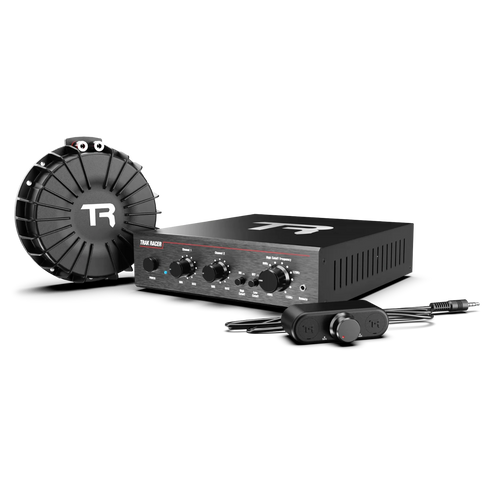
Trak Racer V2 Pro 2CH 200W Kit
The ideal solution to start with a Class-D amplifier and high-power tactile transducer.
This kit combines the strength of a tactile transducer with the clean power delivery of a Class D amplifier, ideal for placing under the seat and instantly translating curbs and bumps.
Dayton Audio BST-1 50W
A high-fidelity bass shaker ideal for DIY builds or placing in strategic points on your aluminum cockpit.
Nobsound NS-01G PRO Amplifier
The compact and economical option essential for powering and modulating the signal of your independent tactile transducers.
2. Feedback Pads (Haptic Seat Cushions)
Feedback pads are integrated systems that are installed directly on the cockpit seat and transmit physical telemetry sensations (ABS, loss of traction, engine vibration, or bumps) to the driver in different body zones. This is a usually plug-and-play solution that can be managed both through SimHub and with the manufacturer's own software.
Sensit Haptics MTC-P Extreme 2
A high-fidelity haptic insert with 14 LRA actuators designed to be placed inside your bucket seat cushions.
HF8 Pro Haptic Feedback Pad
Universal haptic cushion with 8 independent and localized vibration zones to feel the engine and grip.
3. Active vibration systems in pedals
These small motors or actuators are installed on the accelerator, brake, or clutch and reproduce telemetry sensations (engine revolutions, ABS activation, or loss of traction in the rear axle) on the sole of the foot. It is a very solid alternative to get closer to the feel of active pedals with a contained investment.
Brands like MOZA and Simagic offer specific modules natively for their own pedals, achieving excellent integration.

Simagic P-HPR Haptic Reactor for Pedals
Feel ABS, clutch, and loss of traction hyper-realistically in your feet.
Ideal for placing on your simracing pedals and perceiving the brake lock point or wheel slip without having to rely solely on sight.
Haptic reactor comparison
How to choose your ideal haptic reactor
- If you're starting from scratch and want to feel more without changing your steering wheel: A bass shaker kit with an amplifier is the most direct way to add physical and structural feedback to your aluminum cockpit.
- If you're looking for maximum telemetry information on your body: A feedback pad (cushion) will give you more multi-zone nuances (ABS, traction, left/right bumps) than a structural bass shaker.
- If you already use high-end pedals and want to get the most out of them when braking: Pedal vibration makes a tremendous amount of sense as a gameplay complement, especially in models like the Simagic P1000 pedals to fine-tune your technique with ABS.
- If you're looking for the most complete immersion in your simulator: These solutions are not mutually exclusive. They can be progressively combined and integrated with a chassis motion system.
Frequently asked questions about haptic reactors
No. Haptic reactors are independent of physical motion systems. They can be easily installed in any static cockpit to add a sensory layer without the need for a large mechanical platform.
The vast majority of tactile vibration transducers, haptic cushions, and pedal motors are managed through SimHub software, which reads in-game telemetry instantly.
Yes, in fact, it is the recommended approach for high-performance setups. Combining a structural bass shaker for the engine, a haptic cushion for track bumps, and a motor in the pedal for ABS offers excellent car feedback.
All reactors, amplifiers, and peripherals in our catalog come with the manufacturer's official standard warranty. You can resolve any questions about shipping or technical issues through our Simufy FAQ page.

Written by Salva Talens
Professional esports driver and coach, co-founder of Simufy Academy
Engineer and professional esports driver, co-founder of Simufy Academy. He races in the iRacing top split with over 9,000 iRating and has qualified for the Porsche TAG Heuer Esports Supercup. He knows hardware from the only place that matters: lap pace.