




4, 5 or 6-Point Sim Racing Harness: Which Do You Need?

4-, 5- and 6-point sim racing harnesses differ in how they hold the driver in place and where they work best. A 4-point harness is well suited to a conventional static cockpit, while 5- or 6-point harnesses are preferable for motion rigs and belt tensioners. Your choice also depends on the racing seat and its harness openings.
Quick summary
QUICK SUMMARY
4-, 5- or 6-point harness: the essentials
- 4-point harness: recommended for conventional static cockpits (without motion).
- 5-point harness: adds one lower, anti-submarine strap. Recommended for motion rigs or belt tensioners.
- 6-point harness: uses two lower straps to distribute restraint differently. Maximum support for motion simulators.
- Recommended seat: a rigid bucket seat with the required harness openings.
- Reclining sports seats: very limited suitability for harnesses. They can work, but their lower rigidity makes them a less suitable choice.
- Belt tensioner and motion: prioritise a compatible 5- or 6-point harness and mounting setup.
4- vs 5- vs 6-point harness: key differences
The main difference between the number of mounting points is the number of straps and how they hold your body in place, particularly when forces act in several directions.
Compatibility depends on the seat, mounting points and each manufacturer’s installation instructions.
4-point harness: who is it best for?
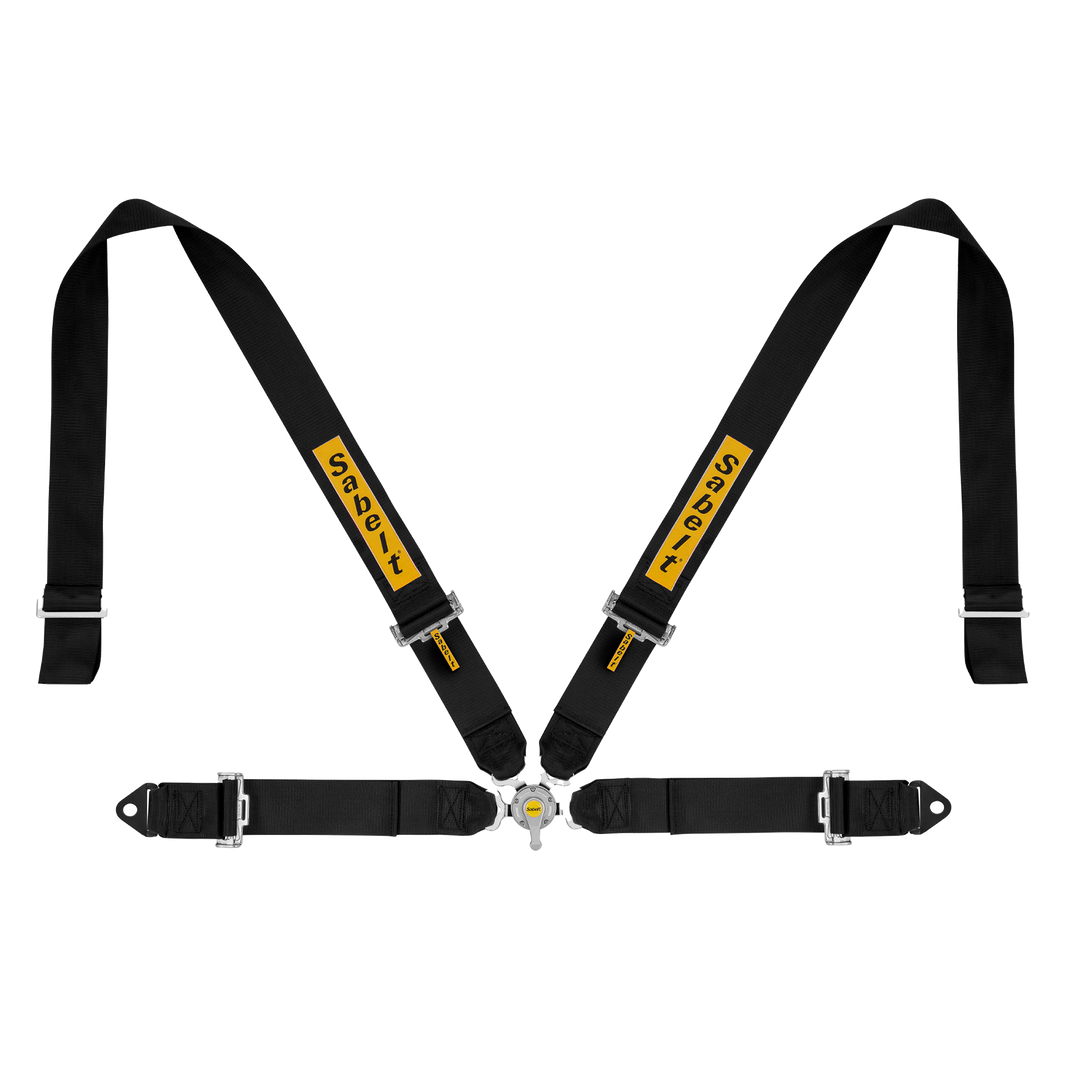
A 4-point harness has two shoulder straps and two lap straps.
It is an interesting choice if you want to hold a consistent driving position and increase immersion. It is best suited to static cockpits, since it does not offer optimal restraint in motion simulators.
The limitation becomes apparent when the shoulder straps are repeatedly tensioned, for example by a belt tensioner. Without a lower strap, the central buckle can ride upwards, placing uncomfortable pressure on your stomach or torso.
That is why it is not our first choice for an active belt tensioner.
Recommended: a conventional cockpit, or a compatible motion cockpit without a belt tensioner.
5-point harness: when do you need an anti-submarine strap?
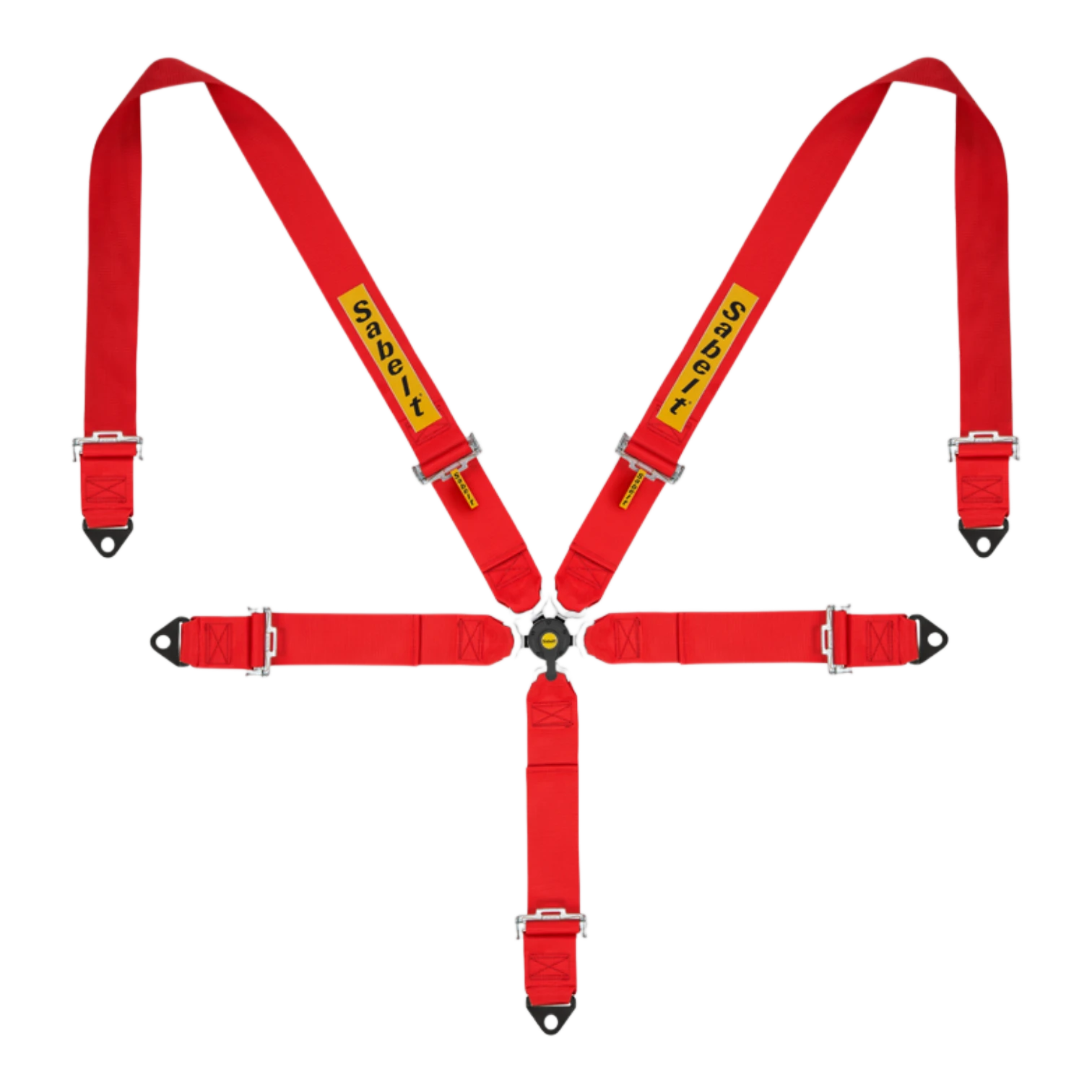
A 5-point harness adds a lower strap that passes between the legs and connects to the central buckle.
Its purpose is to help keep the buckle low, close to the pelvis, preventing it from riding upwards when shoulder-belt tension increases.
This is particularly useful with a belt tensioner, whose actuators tighten and release the straps as you drive.
You need a bucket seat with a lower harness opening and suitable mounting points to install it.
Recommended: motion simulators and compatible belt tensioner systems.
6-point harness: what does it offer over a 5-point?
A 6-point harness uses two lower straps rather than one.
Both designs help keep the central buckle in position, but the 6-point harness distributes the lower restraint differently.
Depending on the driver, seat and mounting points, this may improve comfort and stability.
That does not necessarily mean more immersion than a 5-point harness. The priority is finding a setup compatible with your bucket seat.
Recommended: motion simulators and compatible belt tensioner systems.
When a harness makes sense for your sim rig
Immersion and a consistent driving position
In a conventional static cockpit, a harness keeps your body against the seat and makes the experience feel closer to driving a real racing car.
It is not essential equipment and will not automatically make you faster, but it can provide better support and immersion.
With a motion simulator
As the actuators move the simulator, a harness helps keep your body in a consistent, stable position relative to the seat.
In these setups, we recommend at least five mounting points and checking compatibility with both the seat and the anchorages.
Explore the sim racing motion systems available at Simufy.
With an active belt tensioner
A belt tensioner uses actuators to change harness tension according to what is happening in the simulation, particularly under braking and cornering load.
For this use, we recommend 5- or 6-point harnesses. Their lower straps help stop the central buckle from sliding towards the stomach or torso when tension is applied at the shoulders.
Learn more in our guide to what a belt tensioner is and how it works.
What you need to install a harness
Bucket seat with harness openings
We recommend using a rigid bucket seat designed with harness openings.
Check the shoulder openings, lower side openings and, for 5- or 6-point setups, the lower opening also known as the anti-submarine opening.
Certain reclining sports seats can also be used, but you must pay particular attention to the lower side openings. Shoulder openings alone do not guarantee proper harness fitment. Reclining seats also tend to have more movement in the backrest, so a fixed bucket seat remains our preferred option.
Read our bucket seat vs reclining seat guide and browse racing seats and accessories.
Mounting points on the cockpit
Harness straps must be attached to compatible anchorages and routed according to the manufacturer’s instructions.
Harnesses are often compatible with aluminium-profile cockpits, and a rigid frame provides a stable foundation for installation.
See our guide to choosing a sim racing cockpit and our cockpit accessories.
Common mistakes when choosing a harness
Buying an FIA-homologated harness when you do not need one
A sim rig does not require a harness homologated for real motorsport. Prioritise compatibility with your simulator.
Choosing a seat without harness openings
Check the shoulder, hip and lower openings required for your harness configuration.
Forgetting to check the anchorages
Make sure the cockpit has compatible mounting points and allows the straps to follow the correct route.
Ignoring motion compatibility
For motion rigs or belt tensioners, prioritise a compatible 5- or 6-point harness.
Positioning the buckle too high
The buckle should sit close to the pelvis, never over the stomach or torso, and must be easy to release quickly.
Frequently asked questions about sim racing harnesses
What is the difference between a 4-point and a 6-point harness?
A 4-point harness holds the shoulders and hips. A 6-point harness adds two lower straps that help keep the central buckle low and spread the restraint across the legs.
Do I need a harness for sim racing?
Not necessarily in a conventional cockpit. A harness can improve immersion and support, especially with a motion simulator.
Can I use a real racing harness in a simulator?
Yes, provided its design and mounting points are compatible. However, you do not need an FIA-homologated harness for sim racing.
Can I use a harness with a reclining sports seat?
It is possible, although not our preferred option, if the seat has the necessary openings. Check the lower side openings and, for a 5- or 6-point harness, the lower openings.
Which harness should I use with a belt tensioner?
We recommend a 5- or 6-point harness because the lower straps help keep the central buckle in place as the actuators increase tension.

Written by Salva Talens
Professional esports driver and coach, co-founder of Simufy Academy
Engineer and professional esports driver, co-founder of Simufy Academy. He races in the iRacing top split with over 9,000 iRating and has qualified for the Porsche TAG Heuer Esports Supercup. He knows hardware from the only place that matters: lap pace.


