





How to choose the right Sim Racing cockpit for you

Almost all of us start the same way:office chair, desk and the wheelbase clamped down however we can. It works until it doesn't. The desk shifts under braking, the mount flexes when the wheel starts working properly and the chair rolls backwards just when you need the most precision.
A sim racing cockpit is the rigid structure used to mount the wheel, pedals and seat so you can reproduce the driving position of a racing car and stop the whole setup from moving. Choosing the right one mainly comes down to three factors:the torque of your wheelbase, the space you have available and the type of cars you drive.
In this guide you'll seewhich cockpit suits your situation, what to look for before buying and the mistakes people make most often when making this upgrade.
Quick summary
Before you choose: the 5 questions that define your cockpit
How much torque does your wheelbase produce? And what about in two years?
This is the factor that has the biggest impact on your choice. A cockpit needs toabsorb the torque generated by the wheelbase without flexing: if the structure gives way, you lose force feedback detail and introduce vibrations that aren't coming from the track.
As a general guide: entry-level wheelbases work well with steel chassis; from medium-to-high torque, aluminium profile is preferable; and with high-torque wheelbases or if you're adding motion,large-section aluminium profile stops being a luxury and becomes a requirement.
How much space do you actually have?
Measure before you buy: total length with the pedals in position, width if you're adding a monitor stand and (very importantly) whether the cockpit needs to move or fold away when you're not using it. A 160 cm chassis won't fit in every room, and not every cockpit will fit through a doorway once assembled.
What categories do you actually drive?
Not the ones you'd like to drive: the ones you launch every week.GT3, GT4 and TCR suit a GT/touring position. F1, F2 or prototypes suit a reclined position.If you're still not sure, hybrid options are available.
What are you going to add later?
Handbrake, sequential shifter, inverted pedals, triple monitors, motion.Every addition needs mounting points and profile to attach it to.A cockpit built from standard-slotted aluminium profile gives you room to expand; a closed or less versatile chassis can force you to replace the whole thing.
How many years do you want it to last?
The cockpit is the part of a setup that gets replaced the least.Spread over five or six years, the price difference between an entry-level chassis and an advanced one is often smaller than the cost of buying twice (and that's before we talk about dismantling and rebuilding everything again!).
Sim Racing cockpits by experience level
Cockpits for beginners
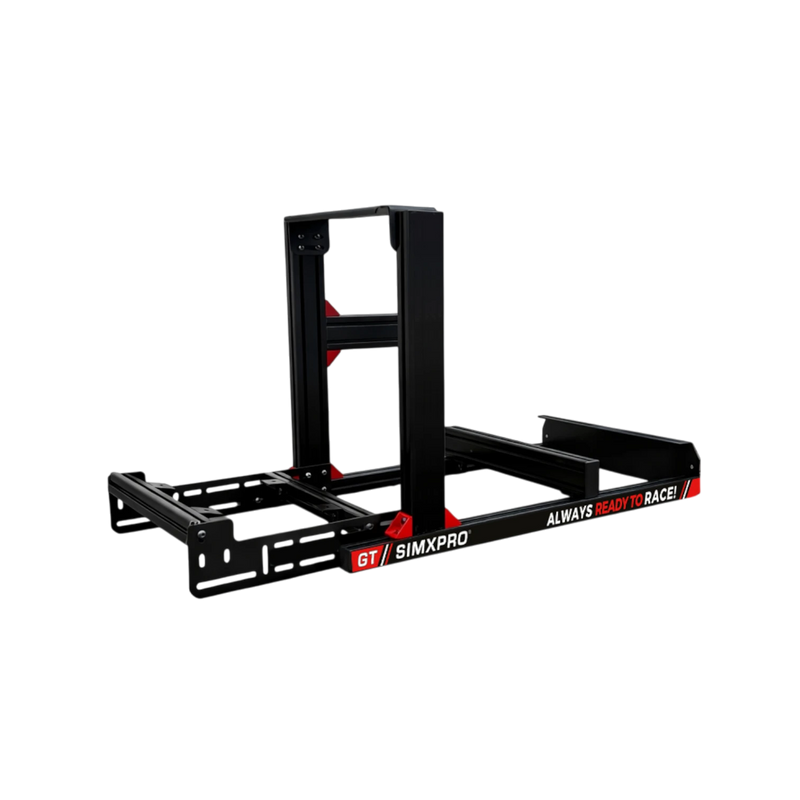
They make a clear difference compared with a desk and office chair:more comfort, stability and a proper driving position. They don't offer maximum rigidity or the greatest upgrade potential, but they usually take up less space and are one of the most cost-effective upgrades you can make.


Intermediate-level cockpits
Designed to stay with you for many years. Structures withfar greater rigidity, more customisation options and a more refined driving position. Their strength is the balance between performance and price.


Advanced cockpits
Advanced sim racing cockpits are designed for the most demanding sim racers. They can easily supportvirtually any sim racing hardware on the marketwhile offering carefully designed driving positions, feel and finish. They're often a platform you can keep indefinitely, so investing in one can pay off over the years.


Level summary table
Cockpits by driving position
Cockpits for a GT driving position
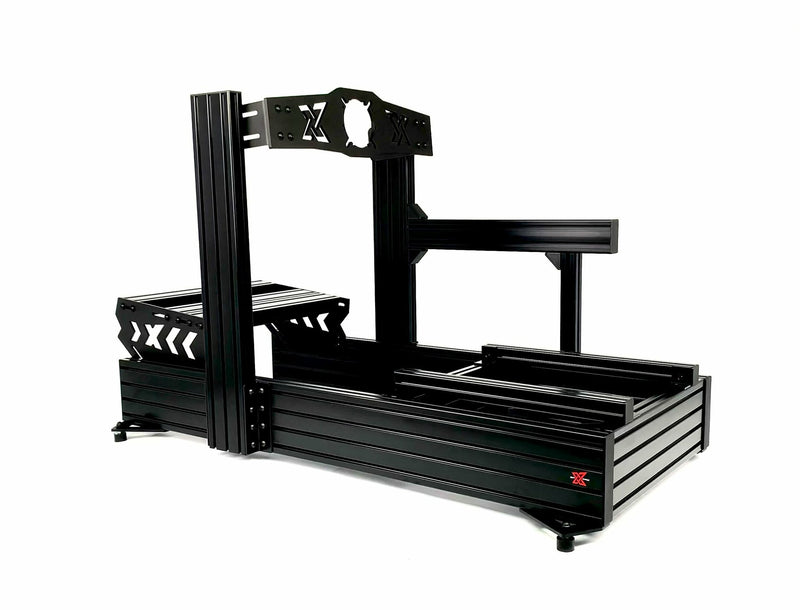
With a cockpit set up in a touring or GT position, you drive in a posture similar to a road car, as used in categories such asGT3, GT4 or TCR. It's the choice of most drivers because of its comfort and versatility, especially during long sessions.


Cockpits for a Formula driving position
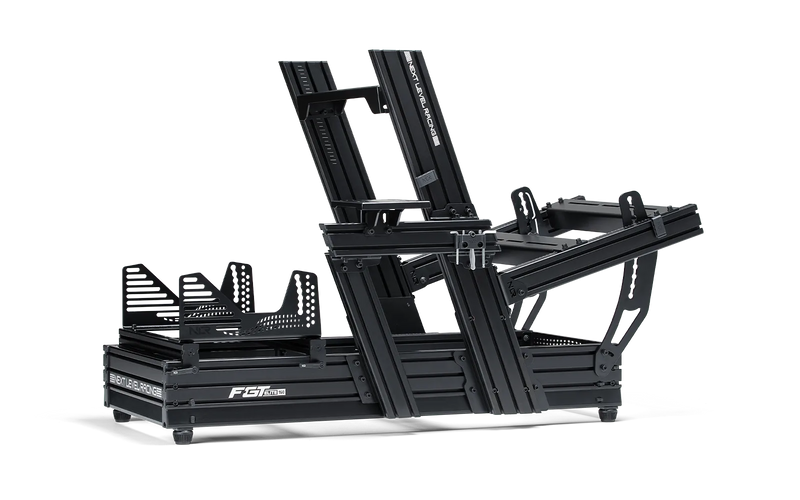
It reproduces the posture of a Formula car (F1, F2, F3), hypercar or prototype:more reclined, with your legs raised relative to your lower back. If this is the type of car you drive most often, it's the right choice.


Hybrid GT and Formula cockpits
They let youswitch between both driving positions relatively quickly. They're the logical option if you haven't settled on a favourite category yet or if more than one person at home uses the simulator with different preferences.
Karting cockpits
They reproduce a kart driving position:sitting close to 90°, very low to the ground and with your legs partially bent. They're less common, but for anyone who trains in real karting there isn't an equivalent alternative.

The 5 most common mistakes when choosing a cockpit
Leaving it until last.
The budget goes on the wheelbase, wheel and pedals, and the cockpit is bought with whatever is left. It should be the other way around: it's the part that lasts the longest.
Sizing it for your current hardware.
If you're going to move to a higher-torque wheelbase in six months, buy for that wheelbase, not the one you have today.
Not measuring the space.
Overall length with pedals, seat height, room to get in and out, and whether it needs to be stored away.
Choosing the driving position for looks.
A Formula position looks spectacular, but if 90% of your laps are in GT3 cars you're going to be uncomfortable.
Forgetting the mounting points.
A handbrake, shifter, inverted pedals and monitor stand all need mounting points planned from the start.
Quick conclusion
Frequently asked questions / FAQs

Written by Salva Talens
Professional esports driver and coach, co-founder of Simufy Academy
Engineer and professional esports driver, co-founder of Simufy Academy. He races in the iRacing top split with over 9,000 iRating and has qualified for the Porsche TAG Heuer Esports Supercup. He knows hardware from the only place that matters: lap pace.


